
How Long Do Acrylic Nails Last? A Nail Tech Answers
The question sounds simple. It isn’t, because it has two different answers depending on what you’re actually asking. How long before you need an infill, and how long you can keep the same set are related but not the same thing. Most articles give you one number and leave you confused about the other. Here’s the full picture.
The Answer Has Two Parts
A professional acrylic nails set needs an infill every two to three weeks. That’s how long it takes before the grow-out becomes structurally significant and visually obvious.
The full set itself can last considerably longer, six to eight weeks with regular infills kept on schedule. You’re not replacing the entire set every fortnight. You’re maintaining it at the point where the new growth meets the existing acrylic.
How Long Before You Need an Infill
Two to three weeks is the standard interval. Some clients with slower nail growth can stretch to four weeks, but four weeks is the outer limit, not the target.
The gap that appears at the cuticle as your nails grow isn’t just cosmetic. Leaving it too long allows moisture to sit underneath the acrylic, which raises the risk of lifting and infection. I’ve seen this happen in the salon — clients who have left it too long come in with nail beds that have turned green or yellow underneath. It looks alarming and it’s entirely avoidable with a consistent appointment schedule.
If you’re regularly leaving it to four weeks or beyond and noticing more lifting or breakage than usual, bringing your appointments forward by a week will almost always make a noticeable difference.
How Long You Can Keep the Same Set
With regular infills, a set can be maintained for six to eight weeks before a full soak-off makes sense. After approximately three infills, I’d recommend a complete removal so the natural nail underneath can be properly assessed. You can’t see what’s happening at the nail plate when it’s been covered for two months, and a proper look every few months is worth building into the routine.
What most clients don’t realise is that a full soak-off isn’t always all or nothing. At each infill appointment I assess each nail individually. Sometimes one or two nails need to come off and be redone entirely while the rest just need filling. That’s normal and it’s part of how a good technician maintains a set properly over time.
One practical point worth knowing: if several nails need redoing at the same appointment, the cost of individual nail repairs can add up to more than a full new set. At that point it often makes more sense to start fresh, and a good technician should flag this honestly rather than charging you for piecemeal repairs that cost more overall.
Why the Two to Three Week Timeline Exists
This is the part most clients don’t know and it’s worth understanding. Acrylics are engineered with an apex, a slight arch built at roughly a third of the way up the nail from the cuticle. The apex is what gives the nail its structural strength. It’s not just a shape choice.
As your natural nail grows, the apex moves further from where it was placed. After three to four weeks, it’s shifted far enough from the cuticle that the nail is no longer properly balanced. A nail in this state will either break at the apex or lift entirely off the nail bed. The two to three week infill schedule isn’t arbitrary. It’s the point at which the structure needs restoring before it fails.
What Shortens Wear Time
Preparation is the biggest variable and it happens before any product is applied. Acrylics applied over any trace of oil, moisture or debris on the nail surface will lift earlier than they should. A rushed preparation at the start of an appointment is the most common reason for early lifting.
Beyond the salon, water exposure is the main factor within your control. Long baths, extended swimming and working with hands in water regularly all soften the bond between the acrylic and the natural nail over time. Household cleaning products do the same. Using your nails as tools, opening cans, peeling stickers, creates mechanical stress at the free edge that shortens the wear time of any nail enhancement.
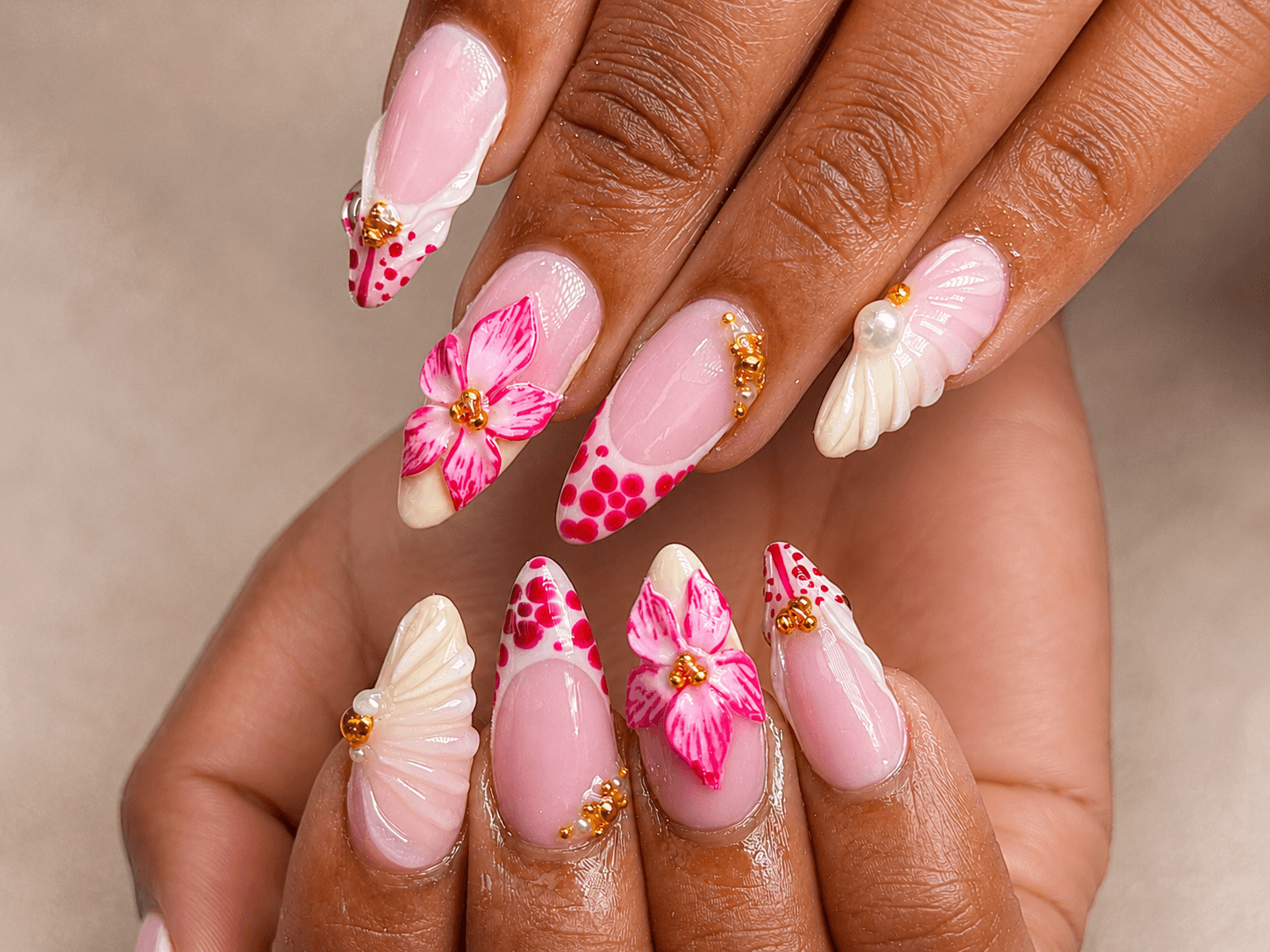
Nail shape also plays a role in my experience. Longer, more tapered shapes like stiletto or almond carry more structural risk than shorter, squarer shapes. The longer the free edge and the narrower the tip, the more leverage there is against the apex when the nail catches on something.
Signs You Need a New Set Rather Than an Infill
If you’re unsure whether your next appointment should be an infill or a full soak-off, these are the things worth looking for.
- Significant lifting across multiple nails. Another infill will sit on top of a compromised base and the problem will repeat faster. Lifting at this scale needs a full removal before anything new goes on.
- Greenish discolouration underneath the acrylic. This is a sign of bacterial growth. The set needs to come off entirely before anything new goes on. Don’t infill over it.
- Yellowing or cloudiness running through the body of the acrylic. If the discolouration is inside the product rather than sitting on the surface, the whole set needs refreshing rather than topping up.
When in doubt, ask your technician directly. A good technician will tell you honestly whether you’re working with something worth maintaining or whether starting fresh is the better call.
How to Make Acrylics Last Longer
Cuticle oil daily. It keeps the surrounding skin flexible and prevents it from pulling against the acrylic edge at the base of the nail. Gloves for washing up and cleaning. Drying hands properly after washing rather than leaving them damp. Avoiding using nails as tools.
Booking your infill on time is the single most effective thing you can do. Letting the interval stretch consistently to four weeks and beyond puts the structure under cumulative stress that shortens how long each set lasts overall. Two to three weeks keeps everything manageable, reduces breakage, and means less work at each appointment.
Related articles
Acrylic Nails: The Honest Guide from a Nail Tech
What acrylics are genuinely good for, the real downsides, what to watch out for in the salon and who they actually suit.
Read more
Gel Nails vs Acrylic: Which Is Right for You
How the two formats compare on longevity, natural look, nail health, cost, time and UV exposure.
Read more
How to Remove Acrylic Nails at Home Safely
The right method, the right products and the steps that prevent thinning and ridging from rushed removal.
Read more